
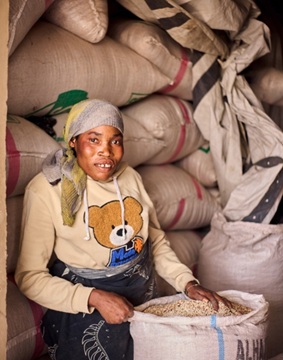
In Guruki, a remote agrarian community in Gombi Local Government Area of Adamawa State, Elizabeth Mohammed, a 28-year-old young woman living with a disability, is quietly redefining what inclusive economic opportunity can look like when young people are equipped with the right skills, confidence, and support systems. Her journey reflects the power of investing in young women and persons with disabilities as agents of growth, not only for themselves, but for their communities.
Before joining the Youth in Work project supported by the Mastercard Foundation and implemented by WFP, Elizabeth’s small grain aggregation and retail business was a means of survival rather than a pathway to growth. Trading mainly in groundnut and millet, she operated without formal business skills, savings mechanisms, or reliable support. Managing both aggregation and retail activities alone was physically demanding and financially risky.
“Before the Youth in Work project, I was not able to save and I struggled a lot to manage my business,” Elizabeth recalls. “Sometimes items would go missing in the shop, and I had to close the retail shop just to go to the market and sell my grains.”
These challenges limited her growth and income. At most, Elizabeth could store about 15 bags of grain, constraining her ability to respond to market demand or negotiate better prices. Like many young women with disabilities in rural areas, she faced compounded barriers such as limited access to finance, minimal bargaining power, and social perceptions that underestimated her ability to succeed as an entrepreneur.
Her trajectory began to shift when she was enrolled in the Youth in Work project in May, 2025, which focuses on equipping young women and men with market-relevant skills and capacities to build dignified and sustainable livelihoods in agriculture and agribusiness. Through structured training sessions, Elizabeth gained practical skills in business management, including record keeping, stock control, savings, and basic financial planning. The project also supported her with essential equipment to improve her business operations and the quality of her produce, including wooden pallets to keep grain bags off the ground, mudu measures (traditional containers used for both selling and measuring grains), and durable storage bags. For the first time, she began to view her grain business as an enterprise with long-term potential.
Leave a Reply